
CNC Turning Service
Prototeque provides precision CNC turning services for custom parts and components. Our CNC machine shop supports a range of turning requirements for prototypes and production projects.
Precision CNC Turning Services | Expert CNC Machining Shop
Prototeque provides CNC turning services with years of machining experience and a range of CNC turning centers. We produce precision components, including complex and intricate turned parts, for various applications.
Our CNC lathe machines support 2-axis to 6-axis CNC turning, Swiss machining, and custom CNC machining for different materials and project requirements.
Our CNC Turning Capabilities
Prototeque’s CNC turning capabilities include a range of turning machines and CNC turning centers for producing components in different sizes, materials, and levels of complexity. Our equipment includes:
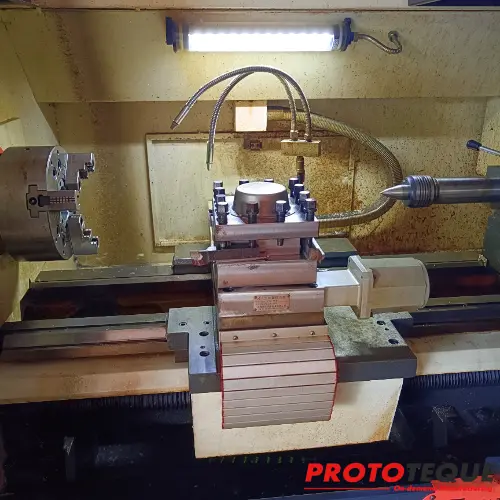
CW61110 Lathe Machine
Large Part Turning
- Max. Turning Diameter: 800mm
- Max. Turning Length: 1500mm
- Suitable for large and heavy-duty turning applications.
Swiss type lathe S205
Small Precision Components
- Max. Bar Diameter: 20mm
- Max. Workpiece Length: 245mm
- Suitable for small-diameter and intricate precision components.


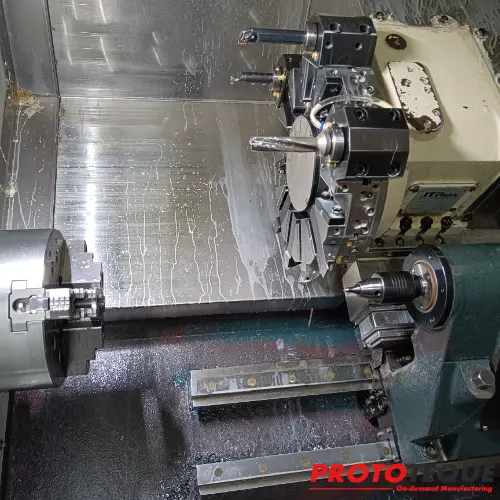
YXB52 Turning Center
Short & Complex Parts
- Max. Turning Diameter: Ø300mm
- Max. Turning Length: Ø350mm
- Bar Diameter: Ø51mm
- Chuck Size: 8 Inch
- Spindle Speed : 4000 RPM
- Live Tooling: 3
CT46 Precision Turret Machine
Long & Complex Components
- Max. Turning Diameter: Ø320mm
- Max. Turning Length: Ø500mm
- Bar Diameter: Ø45mm
- Chuck Size: 6 Inch
- Spindle Speed : 4000 RPM
- Number of Tools: 12
- Number of Axes: 4



Common CNC Turning Materials
Prototeque provides CNC turning services for prototypes, small parts, and high-volume production across various industries.
We work with a wide range of materials, including:
Your questions answered
Common questions
Conventional CNC Turning vs. Swiss CNC Turning
Understanding the Differences
Conventional and Swiss CNC turning are both essential manufacturing processes, each with its own strengths and weaknesses.
Swiss CNC Turning is ideal for producing high-precision, small-diameter, and often long parts in large volumes. While it requires a higher initial investment, it offers exceptional accuracy due to its guide bushing system that holds the workpiece securely. This method allows for simultaneous machining with multiple cutting tools, boosting production efficiency. However, Machine setup and programming is more complex, leading to higher sampling costs.
Conventional CNC Turning is generally more cost-effective and suitable for larger, simpler parts. It’s often preferred for rapid prototyping of large components due to its easier Machine setup and programming
. However, it’s limited in precision compared to Swiss CNC turning and doesn’t allow for simultaneous machining with multiple tools.
In summary, the choice between conventional and Swiss CNC turning depends on factors such as part size, complexity, required precision, production volume, and budget.
What factors contribute to the high cost of Swiss turning prototypes?
High Equipment Costs: Swiss-type lathes are specialized machines with a significantly higher price point compared to conventional lathes. This limited availability and high investment cost is often reflected in prototype pricing.
Specialized Application: Swiss turning excels in producing high-precision, small-diameter parts, limiting its application range. This specialization contributes to higher costs due to lower machine utilization.
High-Volume Efficiency: Swiss lathes are optimized for mass production, making them less efficient for the smaller quantities typical of prototyping.
Skilled Labor: Operating Swiss-type lathes requires specialized expertise, and skilled technicians command higher salaries. This labor cost is reflected in prototype pricing.
Complex Setup: Achieving the high precision of Swiss turning involves intricate machine setup and programming, increasing production time and cost.
High Machine Utilization: Due to the high demand for precision components produced on Swiss lathes, these machines often operate at near-capacity. Unless you’re a long-term business partner, securing machine time for prototyping can be challenging and costly as manufacturers prioritize ongoing production orders.
CNC Lathe vs CNC Turning Center
A CNC lathe and a CNC turning center are both computer-controlled machines used to remove material from a workpiece to create a desired shape. However, there are key differences in their capabilities and applications.
CNC Lathe
Basic functionality: Primarily designed for turning operations, such as creating cylindrical shapes.
Simplicity: Often simpler to operate and set up compared to turning centers.
Cost-effective: Generally more affordable than turning centers.
Ideal for: Smaller production runs, simple parts, and quick repairs.
CNC Turning Center
Versatility: Offers a wider range of capabilities beyond turning, including milling, drilling, and boring.
Automation: Equipped with features like automatic tool changers and live tooling for increased efficiency.
Complex parts: Suitable for producing complex parts with multiple features in a single setup.
Higher investment: Typically more expensive due to advanced features and capabilities.
In summary, a CNC lathe is a specialized machine for turning operations, while a CNC turning center is a more versatile machine capable of performing a variety of machining tasks. The choice between the two depends on the specific needs of the project, such as part complexity, production volume, and budget.
What is CNC turning?
CNC turning is a manufacturing process that utilizes a computer-controlled lathe to shape materials like cylinders, bars, and hexagons. This process involves securing the workpiece in a chuck, rotating it at high speeds, and employing cutting tools to remove excess material, resulting in the desired shape.
Common CNC turning machines include lathes, Swiss-type lathes, turning centers, and automatic lathes & cam Auto Lathe.