
CNC Plastic Machining
We specialize in CNC plastic machining, offering CNC milling, turning, and other machining services. We produce custom machined plastic parts to meet your specifications, from prototypes to production runs.
Prototeque: Precision CNC Plastic Machining Experts
Prototeque provides CNC plastic machining services with over a decade of experience. We produce precision plastic components through CNC turning and milling, including intricate and complex parts.
From small-scale prototypes to high-volume production, our plastic machining capabilities support various project requirements and specifications.
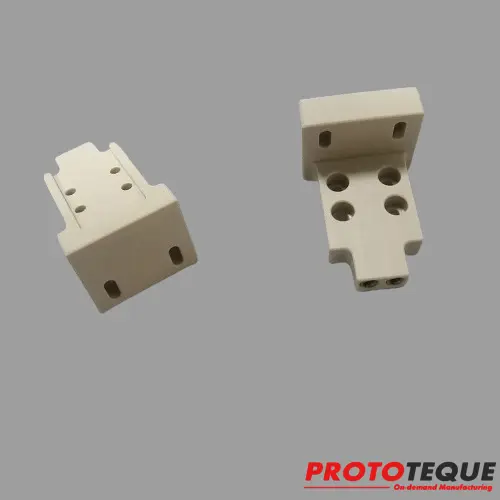


Prototeque's Expertise in CNC Plastic Machining
Prototeque specializes in precision CNC plastic machining, working with a variety of plastic materials to meet different project requirements. Depending on the application, we can machine plastics with properties such as durability, lightweight performance, and chemical resistance. Common plastic materials we machine include:
PTFE / Teflon
POM
ABS
PP
PEEK
Nylon
Prototeque's Stock of CNC Machinable Plastics
Benefit from faster production with Prototeque’s inventory of CNC machinable plastic sheets and rods.
We use quality virgin materials to produce precision machined plastic parts. By sourcing directly from reputable manufacturers, we can offer competitive pricing and consistent material quality.
Our in-house stock helps support faster turnaround times for projects requiring commonly used plastic materials
Conquering the Challenges of Precision CNC Plastic Machining
Achieving precise dimensions in CNC machined plastic parts requires careful control. Unlike metals, plastics such as POM, PTFE, and PP can be susceptible to shrinkage and dimensional changes.
To maintain accuracy, Prototeque uses a two-step machining process that combines rough machining with controlled stabilization before final machining. This helps minimize material movement and achieve the required tolerances for precision plastic components.
Your questions answered
Common questions
Is CNC more expensive than 3D printing?
Generally, yes, CNC machining tends to be more expensive than 3D printing.
The primary reason for this cost difference lies in the production process. 3D printing is an additive process, building up a part layer by layer, often using less material and requiring less labor. Costs are typically calculated per gram of material used.
On the other hand, CNC machining is a subtractive process, removing material from a block to create the desired shape. This involves higher equipment costs, skilled labor, cutting tools, and extensive setup time. As a result, CNC costs are usually calculated by the hour.
However, it’s essential to consider the specific project. For small-scale, complex parts, 3D printing might be more cost-effective. But for large-scale production of parts with tight tolerances, CNC machining often becomes more economical.
Ultimately, the best choice depends on factors such as part complexity, material requirements, desired quantity, and overall budget.
What is CNC plastic?
CNC plastic refers to plastic parts produced through Computer Numerical Control (CNC) machining. This manufacturing process involves using computer-controlled machines to shape plastic material into precise components.
Unlike 3D printed plastics, which are often used for visual prototypes or concept models, CNC plastic parts are typically created for functional testing and validation.
Key benefits of CNC plastic parts include:
Rapid prototyping: CNC machining allows for quick production of small batches or even single units, accelerating the design and development process.
Functional testing: CNC plastic parts accurately represent the final product’s functionality, enabling thorough testing and refinement before investing in expensive plastic molds.
Design validation: Engineers and designers can physically examine and modify CNC plastic parts to ensure the design meets requirements before committing to mass production.
By utilizing CNC plastic parts, companies can significantly reduce time-to-market and improve product quality by identifying potential issues early in the development cycle.
What is the difference between 3D printing, CNC machining and injection moulding?
3D Printing
Additive process: Builds parts layer by layer.
Rapid prototyping: Quick production, ideal for design validation and testing.
Limited material options: Fewer material choices compared to other methods.
Lower strength and precision: Often used for cosmetic checks rather than functional testing.
Best for: Small quantities, complex geometries, and initial concept validation.
CNC Machining
Subtractive process: Removes material from a solid block to create the desired shape.
Versatility: Capable of machining a wide range of materials.
High precision and strength: Delivers accurate and durable parts.
Suitable for: Small to medium production runs, functional prototypes, and end-use parts.
Higher cost per part: Due to labor, machine, and tooling costs.
Injection Molding
High-volume production: Ideal for large quantities of identical parts.
Lowest cost per part: Efficient process with high output.
High initial investment: Requires mold creation, which can be expensive.
Limited design flexibility: Changes require mold modifications.
Best for: Mass production of consistent parts with high precision and strength.
What would be some advantages of CNC over 3D printing?
Advantages of CNC Machining Over 3D Printing
CNC machining offers several advantages over 3D printing, especially when it comes to plastic parts.
Strength and Durability: CNC machined plastic parts generally exhibit superior strength and durability compared to their 3D printed counterparts. This is due to the nature of the processes involved.
Material Versatility: CNC machining can be applied to a wider range of plastic materials than 3D printing. This provides greater flexibility in material selection to match specific application requirements.
Precision and Accuracy: CNC machining excels in producing parts with precise dimensions and tolerances, surpassing the capabilities of most 3D printers. This is crucial for components that require tight fits or specific performance characteristics.
Functional Testing: CNC plastic parts are primarily used for functional testing due to their accuracy and strength. In contrast, 3D printed parts are often employed for visual and aesthetic assessments.